Friday, December 21, 2012

Yoga Practice Tips for the Holidays, Part 2: DVDs

 In Yoga Practice Tips for the Holidays, Part 1, I gave you a link for viewing and downloading a series of Iyengar Yoga practice sequences.   These sequences may be all you need for your own home practice. 

Another suggestion for practicing that you might enjoy is to follow along with a yoga DVD.   The benefits from a good yoga DVD is that you'll be given instructions for doing the poses, sometimes with suggestions for modifications and the use of props. 

There aren't many Iyengar Yoga DVDs unfortunately, but you might enjoy trying out DVDs that present different styles of yoga.

Check out your local library for yoga DVDs.   My local library, the Ann Arbor District Library has a number of yoga DVDs to choose from.  

Here is a sampling of DVDs to take a look at (the "More info" takes you to each DVD's Amazon page):

The first one, Yoga for Beginners with Patricia Walden is a nice, slow-paced beginning level Iyengar Yoga DVD.  
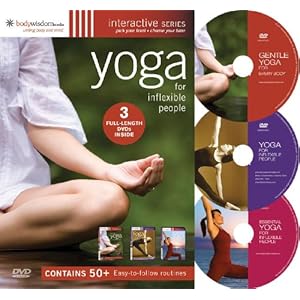
Yoga for Inflexible People includes poses taught in the Iyengar Yoga style with suggestions for props for modifications for stiff people. It also includes some flow yoga routines.
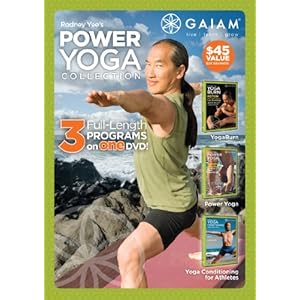
The Rodney Yee Power Yoga DVD is for those of you who really want a "work-out". Rodney Yee isn't an Iyengar Yoga teacher, although he started as one.
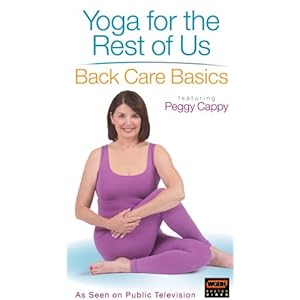
The last DVD, Yoga for the Rest of Us, is one of a series of Gentle Yoga DVD's by Peggy Cappy.

Wednesday, December 19, 2012

Yoga Practice Tips for the Holidays, Part 1: Practice Sequence Sheets

What do you do when your yoga class isn't taught for a week or two, such as during the holiday season?   Many of my students come back after the holidays (or after vacation or illness) saying how much they missed their yoga classes, and how stiff they are now, and how glad they are that their yoga class is back in session again.

I'm glad that people miss their yoga classes, and are eager to get back again!   But I also hope that people will take some time to practice on their own in between classes, especially if there's a break of a week or more.   Some of you do practice, but I know that many don't.

Over the next few days, I plan to post a few suggestions for practicing on your own during the holiday season, or for any time you can't attend classes for awhile.   I hope that these ideas will spur you on to practicing at home in between your regular classes as well, and not just during holiday breaks.

Those of you who get the Harmony Yoga of Ann Arbor eNewsletter will have already seen this suggestion:

On the IYNAUS (Iyengar Yoga National Association of the United States) site, there are links to practice sequences that you can print out or save to your computer:

Sequences for Yoga Practice (These are pdf files.)

There are four Level 1 sequences, and four Level 2 sequences.    Use these as guidelines for your own practice.   You may not do all of the poses on a sequence, and you might not be able to do the poses as shown.   If you've been taking classes from me for awhile, you'll probably remember how to modify these poses so they are appropriate for your own practice.  Use props as necessary, as we do in class.  For the Gentle Yoga group, use walls and chairs for support.   Ask me before or after class if you're not sure how to modify these poses.

On the sequences there are suggested timings for holding the poses.  You might hold for much shorter times, or you might decide to hold for longer if you're working on stamina.  Don't hold so long that you feel strain in the poses.


Wednesday, November 21, 2012

Day After Thanksgiving Class Nearly Full

Since I can't currently post successfully to Harmony Yoga's Facebook page, I'm hoping a few of you see this here instead:

The Day After Thanksgiving Yoga Class is nearly full, and may not be able to fit in drop-ins.  If you're interested in attending and haven't already registered, please contact me.

 In any case, have a Happy Thanksgiving!

Sunday, November 4, 2012

Interview / YouTube video of Senior Iyengar Yoga Teacher Dean Lerner

This video of an interview with Senior Iyengar Yoga teacher, Dean Lerner, is well worth watching and listening to a number of times.

A few of the comments that Dean makes that especially resonate with me include:
  • When Dean first started reading Light on Yoga by B.K.S. Iyengar, he said he was like a thirsty man in the desert, and reading Light on Yoga was like drinking water for his soul.
  • When Dean Lerner wrote to Guruji (B.K.S. Iyengar) with questions about the poses in Light on Yoga, Dean said he can't do the poses like Guruji does in the book -- that they're uncomfortable.  Iyengar wrote back saying, "I’m not concerned with your comfort but with the precision in which you do the poses."   This made an impression on Dean.  Comfort is not the point in the poses, but how we're moving in the poses, and how our consciousness is moving, so we face the difficulties properly.
  • The postures are used to affect the mind.  When we learn to quiet the mind, we're on the road to bliss.  We start to find that unity within ourselves.
  • If we're not alert to how we practice, we lean toward practicing what is easy for us, and avoiding that which is difficult.    We need to develop an even state of mind for all poses, easy and difficult.   We need to find where the difficulties lie so we can overcome them.
  • Practicing and observing our consciousness leads us inward to the core of our being.
  • Long, uninterrupted, and intelligent practice is how we progress in our study of yoga.   At first the practice of yoga is a discipline, but with continued long, uninterrupted, intelligent practice, it becomes a passion.

Wednesday, October 31, 2012

Zombie Yoga -- Happy Halloween!

These delightful zombie yogis are creations of Rob Osborne. You can find his Yoga SuperPop collection on Etsy.

Thursday, October 18, 2012

Can We Achieve the Perfect Pose?

Can we achieve the perfect asana, or yoga pose?   What is the perfect yoga pose?  Is it important to work toward the perfect pose?  

The "ideal" classical form of any pose, as shown by high level yoga practitioners, won't be accessible in that same form by most people, especially those who are older and stiffer, or who have various health and mobility issues.  They'd injure themselves if they forced their bodies to conform to what we might consider "the perfect pose"!   But that doesn't mean they should stop working toward the ideal pose for their own body, even though the shape or emphasis of that ideal pose will change over time.

That makes sense, of course.   Consider the poses you see on the cover of Yoga Journal, or in the YJ calendar.  These are beautiful poses done by young, fit people.   But as we age, our body obviously changes, and our strength and flexibility will diminish.  But our awareness of our bodies grows as we continue our practice, and we can work more intelligently in the poses even though we might not be as strong or flexible as we once were.

In the Yoga Sutras of Patanjali, two sutras especially speak to this:
II: 46 Sthira sukham asanam
Or as translated by B.K.S. Iyengar in Light on the Yoga Sutras of Patanjali, "Asana is perfect firmness of body, steadiness of intelligence, and benevolence of spirit."  He comments that, "whatever asana is performed, it should be done with a feeling of firmness, steadiness and endurance in the body, goodwill in the intelligence of the head, and awareness and delight in the intelligence of the heart." and "in any asana, the body has to be toned and the mind tuned so that one can stay longer with a firm body and a serene mind."

II:47 Prayatna saithilya ananta samapattibhyam
or "Perfection in an asana is achieved when the effort to perform it becomes effortless and the infinite being within is reached."   He goes on to say, "perfection must be attained through perseverance, alertness and insight. Without these we remain dull and make no progress."    But the struggle to perform the asana is gone, while we maintain our firmness of body, intelligence of mind and benevolence of spirit.  There's a balance between effort and relaxation (such that it is) in the pose.

Wednesday, August 1, 2012

How to Be a Good Yoga Student

The Yoga Sutras of Patanjali IFor awhile I've been mulling over what I think the characteristics are that define a good yoga student.   Being a good yoga student doesn't necessarily mean being able to do all of the yoga poses well, but it's more of an attitude of respect and a willingness to keep an open mind and to try your best in class that's important to me.

Here's a page I recently wrote on this:


Most of it is very practical advice.  Read through it and see which guidelines you follow and which you could do better with.

Some of these guidelines and ideas may not be as important in some yoga classes as in others, but they'll give you a good starting point for how to be a good yoga student in the classes you take.

Are there other guidelines for being a good yoga student that make sense to you?
Yoga / Meditation Poster
At Allposters.com